EOO-007 · Jul 19, 2026 · 9 min read · Markdown
Kimi K3 Reaches the Coding Frontier. Here's the Catch
George Lydakis + GPT-5.6 Sol
Kimi K3 arrived this weekend with a striking promise: a model that can compete with the best closed coding agents, with its full weights scheduled for release on July 27.
The obvious question is whether K3 is actually this good, or whether the leaderboard is hiding a catch.
We now have unusually useful data for answering that. DeepSWE ran K3 on 113 original software-engineering problems, with four attempts per problem and tests that verify whether the code really works. I downloaded the public attempt-level data and compared K3 with Claude Fable 5 and several versions of GPT-5.6.
My short answer:
K3 is genuinely in the coding frontier’s neighborhood. But it looks more like a much cheaper Fable than an open Sol. Its advantage is price and promised ownership, not a more efficient way of working.
That distinction is the story.
Yes, K3 is really up there
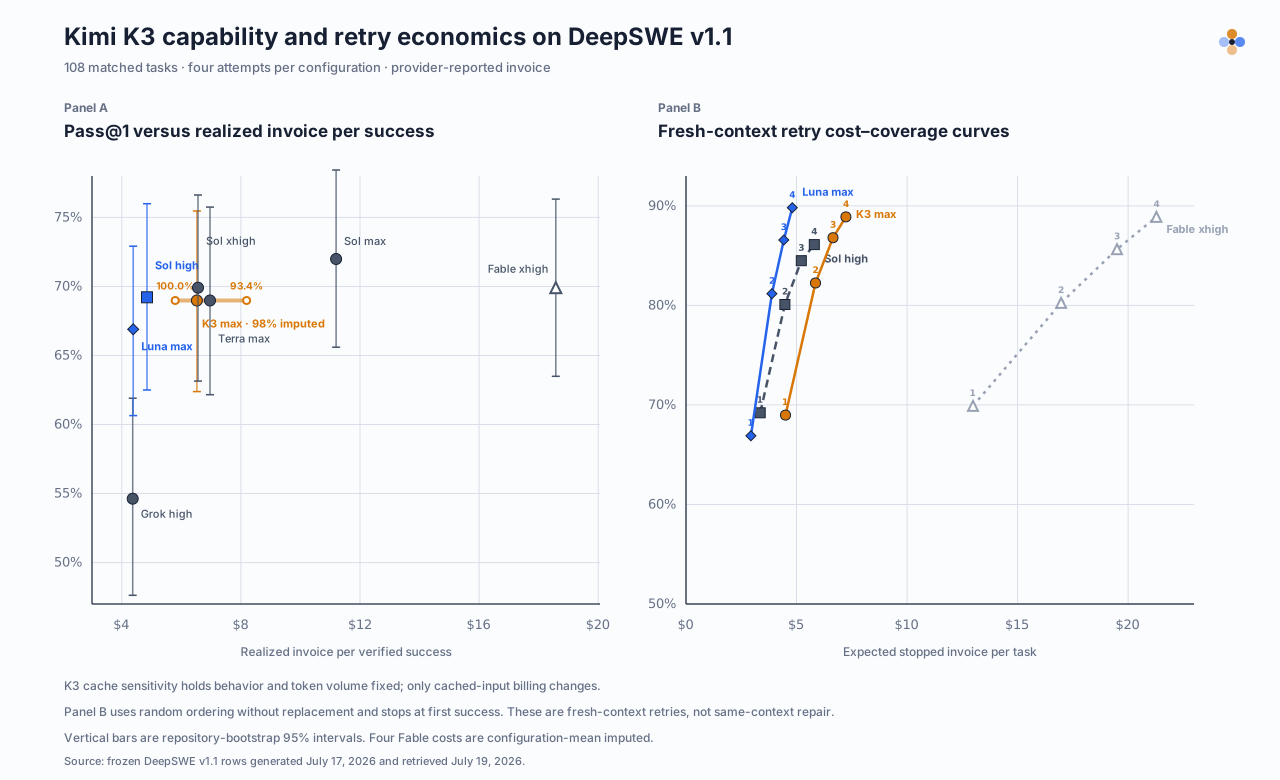
On the 108 problems where the main configurations have a complete set of attempts, K3, Fable, and GPT-5.6 Sol high all solve about 69% of runs.
| Model | Verified success rate | Invoice per verified success |
|---|---|---|
| Kimi K3 max | 68.98% | $6.52 |
| GPT-5.6 Sol high | 69.21% | $4.85 |
| Claude Fable 5 xhigh | 69.91% | $18.57 |
The small score differences between these three are not statistically resolved. This data cannot tell us that K3 is better than Fable or Sol. It does tell us that K3 is compatible with the same broad capability band.
That alone is surprising. Moonshot describes K3 as a 2.8-trillion-parameter model and says the full weights are coming. It also acknowledges that the model still trails Fable and Sol overall. On these difficult coding tasks, however, K3 is already close enough that the more interesting questions are about how it gets there and what it costs.
K3 looks like a cheaper Fable
Two models can reach the same overall score while solving different problems. That matters when you do not know what the next task will be.
So I compared the models problem by problem, after accounting for which problems were generally easy or hard for everyone. K3’s pattern of wins and losses was much closer to Fable’s than to Sol high’s.
The adjusted K3-Fable correlation is 0.614. The K3-Sol high estimate is close to zero, and the uncertainty crosses zero. In plain English: when K3 is unusually good or bad at a problem, Fable tends to move in the same direction. Sol does not show the same consistent resemblance.
This does not mean K3 reasons like Claude, shares its training data, or copied its behavior. Test results cannot establish any of that. It means something narrower and useful: on this benchmark’s task outcomes, K3 looks like a cheaper Fable, not an open Sol.
The comparison with Kimi’s previous coding model makes the jump look even larger. K3 retains nearly everything K2.7 could solve and adds 36 more solved problem identities. Yet its adjusted outcome pattern is far closer to Fable than to K2.7. K3 is not merely a slightly better version of the old Kimi frontier in this data.
The catch: cheap tokens, not frugal behavior
K3 costs roughly one third as much as Fable per verified success. But that does not mean it does one third of the work.
On successful runs, K3 and Fable produce nearly the same amount of output. Sol is much leaner.
| Successful run | Kimi K3 | GPT-5.6 Sol high | Claude Fable 5 |
|---|---|---|---|
| Agent steps | 98.6 | 35.2 | 68.5 |
| Output tokens | 80.7k | 27.9k | 78.6k |
| Invoice | $4.64 | $3.25 | $13.01 |
This gives us two very different comparisons.
Against Fable, K3 uses a broadly similar volume of output but buys it at a dramatically lower price. Against Sol, K3 takes about 2.8 times as many steps and produces about 2.9 times as many output tokens. Its cheaper unit prices are not enough to erase the extra work.
K3 has cheap tokens, not frugal behavior.
The cost breakdown says the same thing another way. About 82% of K3’s cost disadvantage to Sol comes from spending more on runs that eventually succeed. The remaining difference, the cost of failed runs spread across successes, is small and statistically unresolved.
So the main catch is not that K3 fails much more often. It is that a successful K3 trajectory is heavier.
The second catch: the discount favors long jobs
K3’s reported bill depends heavily on prompt caching. When an agent repeatedly sends much of the same conversation back to the model, a provider can reuse previous work and charge a lower input price.
DeepSWE’s K3 endpoint did not report how many tokens were actually cached. The published rows assume a 98% cache-hit share. That is an estimate, not a measurement.
I compared that assumption with 54 existing K3 coding runs from our separate ShallowSWE research. The measured share was 93.42% overall. Short runs reached roughly 78% to 85%; the few very long runs approached 96%.
If DeepSWE’s K3 runs had matched the observed 93.42% share, its invoice per verified success would rise from $6.52 to $8.19. K3 would still be far cheaper than Fable, but farther behind Sol high.
This produces an unusual economic shape. K3 gets more attractive as a session becomes long enough to amortize its cold start. The 98% assumption may be plausible for very long coding sessions, and Moonshot says its official API exceeds 90% cache hits on coding workloads. But it should not be treated as a measured property of these DeepSWE runs or assumed for every short task.
Why would someone still choose Sol or Fable?
A benchmark gives the agent a defined problem. A person choosing an everyday model usually does not know what kind of problem will arrive next.
That changes the purchase. You are not only buying the probability that a test passes. You are buying insurance against unfamiliar work, plus the experience of explaining an ambiguous idea, correcting the model, and collaborating over time.
This is why Luna is an instructive side note. In this dataset, GPT-5.6 Luna is an excellent spreadsheet choice: it is cheaper than K3 and reaches a statistically compatible share of problems after repeated fresh attempts. Yet many people with access to Sol will still choose Sol. They value the larger model’s understanding and the quality of the working session, even when a cheaper model looks better on a measured task.
DeepSWE does not measure that experience. Moonshot’s own K3 launch notes concede a noticeable user-experience gap to Fable and Sol. They also warn that K3 can be overly proactive on ambiguous requests and that compatible handling of its thinking history matters. Those are real product catches that a pass rate will miss.
Sol’s case is therefore straightforward: in this benchmark it matches K3’s success rate while using much less work and costing less. It also comes inside a mature, managed agent experience.
Fable’s case is less visible in these numbers. Its invoice is much higher, but its appeal can include the conversational and product qualities the benchmark does not score. If those qualities do not matter for a well-specified automated workload, K3 puts Fable’s price premium under real pressure.
So why use K3?
If you are choosing strictly from this dataset:
- Over Fable: K3 offers similar verified coding outcomes at about one third of the invoice under the 98% warm-cache assumption.
- Over Sol: K3 does not win on benchmark economics. The reason to choose it is the prospect of owning, customizing, auditing, or serving the model through more than one provider.
- For short jobs: be careful with the headline price. K3 has less opportunity to amortize its uncached prefix.
- For ambiguous, interactive work: test the product, not just the checkpoint. The benchmark does not measure whether you enjoy working with it.
“Open” also needs qualification. At the time of writing, the weights are promised, not yet released. And a 2.8-trillion-parameter sparse model is not a casual laptop deployment. Moonshot recommends systems with at least 64 accelerators. Open weights create provider competition and deployment control, not necessarily cheap self-hosting.
That is still strategically important. A model does not need to beat every closed system to change the market. It only needs to get close enough that ownership, customization, and price become part of the decision.
My read
K3 did not beat the coding frontier in this dataset. It made the frontier look less proprietary.
Its Fable comparison is genuinely disruptive: nearly the same verified success rate, a similar pattern of task outcomes, and a radically lower invoice. Its Sol comparison supplies the catch: nearly the same success rate, but far more steps and output, with worse economics even after cheaper token prices.
So I would not call K3 the best coding agent. I would call it the first promised open-weight model in this data that makes the closed frontier feel optional.
The capability frontier barely moved. The ownership boundary might.
Data and methods
This is an exploratory reanalysis of the public DeepSWE v1.1 leaderboard, trial index, and task index, generated July 17, 2026 and retrieved July 19.
The main comparison uses 108 tasks across 88 repositories, with four scored attempts for every configuration. Uncertainty intervals come from 10,000 repository-cluster bootstrap samples. Costs are provider invoices rather than estimates at a shared price. Four Fable costs are filled with that configuration’s observed mean. The 98% K3 cache allocation is the DeepSWE row assumption, not endpoint telemetry.
The outcome-pattern analysis controls for shared task difficulty. The primary adjusted correlations are 0.114 for K3 versus K2.7 and 0.614 for K3 versus Fable. Their 0.501 difference has a 95% repository-bootstrap interval of 0.301 to 0.698. The result is robust across 15 reasonable variants of the analysis, but it identifies similarity in outcomes, not a training or reasoning mechanism.
The retry chart reconstructs policies from independent, fresh-context attempts and stops charging after the first success. It does not simulate an agent repairing its prior work. The cache comparison uses 54 separate ShallowSWE K3 repair-loop attempts, not the DeepSWE endpoint.
The original economic analysis and reproducible package are in the ShallowSWE repository.
Frozen source SHA-256 hashes:
leaderboard  050663ae245106a7fc59312565059f46bd6ee10fa587131dd09a5062af5ed24d
trials       6c010fb3e03c7eafc189be320b17ff4aaaf07d40a5910c81992d83aa155a2802
tasks        bae967f6472943564c3fc5232fba3c8e0ac465c1be5ccf9dd4895d4ee9df6242